open conversation makes me happy
I like it when people have low standards for who they talk to
Recently, my friend Melody learned I started a blog and assumed she was partially responsible for my recent articles on how criminal justice should be handled in the abstract.
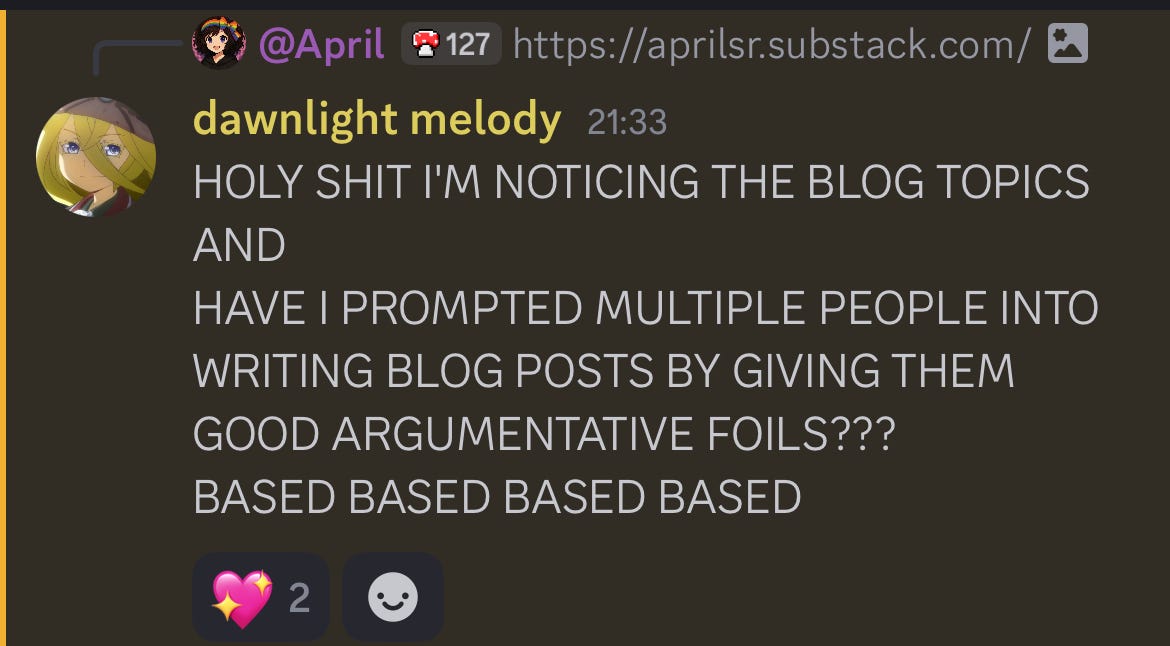
This was incorrect, but I am happy to fulfill her wish to have prompted people into writing blog posts. Indeed, I too was excited to see that she has started blogging more partially because of me. I am not yet practiced in the art of consistently being able to find an idea I’m capable of writing at much length about, so I will very happily take what I can get.
So. Occasionally one sees people say things like “our kind can’t even cooperate to not talk to Cade Metz”. Now, I recently invited to my apartment the infamous rationalist Zachary Davis, who told me a little about his experiences talking with Cade Metz (a few excerpts from their conversations can be found here and here). And one of the things he said from the first of those posts has always stuck with me:
So, when we met at the Pause AI protest on February 12th, I mentioned that people in my social circles would say, “Don’t talk to journalists.” Actually, I want to amend that, because when I later mentioned meeting you, some people were more specific: “No, talking to journalists makes sense; don’t talk to Cade Metz specifically, who is unusually hostile and untrustworthy.”
(…)
I’m frustrated with the people who are saying, “Don’t talk to Cade Metz,” because I have faith. I am so serious about the free speech thing that I’m willing to take the risk that if you have an honest conversation with someone, they might quote your words out of context on their blog.
I admire the faith! I admire the seriousness about the free speech thing and the dedication to having honest conversations. I can only hope I have provided sufficient context on my blog.
Now, I very well might have ended up doing it either way, but I think people like Zack were part of what inspired me to try to talk somewhat openly about the Zizians11 It would just be silly to shy away from discussing this example in this specific post. Besides, the topic of journalists asking about Zizians made it into the latest Bay Area House Party, which means I have the necessary social permission to acknowledge this phenomenon despite the pressures against open conversation., even to journalists (of all people) who messaged me. And you know, lots of people say not to talk to journalists, and I can be anxious by nature, and it’s easy to imagine a version of me who feels that she has to be super paranoid who she talks to and what she says all the time. I’m not, like, against all secrecy and privacy ever, but I think it can often get excessive.
Relatedly, another example in my mental filing cabinet of arguments over who it’s okay to talk to is that time everyone got mad at Jessica Taylor for talking to Andy Ngo about the Zizians. I remember her saying something about a “unilateralist’s blessing”, which I assume was trying to get at something sort of like “people being afraid of doing things for unilateralist’s curse reasons leaves free opportunities to do good on the ground.”
And like, in all of this, I don’t think Cade Metz’s articles are very good22 Okay, I didn’t actually mind the recent(ish) one on Light Haven too much. How could I be upset when my tweet on it made it into a Cabinet of Curiosities video. This is likely because I am fonder of religion than many others in my community.
I do think it would have been better if it had included the quote Zack described to me about how he thinks rationalism is sort of like a religion in some ways, except for the part where rationalist beliefs are often actually true.. I think Andy Ngo sucks. It does seem to me that maybe people overstate how big a deal a crummy article is, but, well, that certainly doesn’t make them any good.
Quasidubious Virtues
The way people occasionally get really mad at people for talking to people they consider bad, and the way I do not exactly have refutations to all their arguments, has led me to relate to this sort of openness as something of a Dubious virtue, though it’s a different flavor of dubiosity from Sensei Soares’s examples. It’s like pacifism. Deep in my soul, I really really fucking admire pacifism. I kind of want everyone to be a pacifist. People should, my heart cries out, have a true uncompromising devotion to never killing another being.
But the issue with pure hardline pacifism is that it isn’t actually the best thing for the world, as much as I wish it were! Sometimes you need to stop the Nazis from hurting Jews. Sometimes you need to fight a defensive war. There are things that are worth it. It’s just, I cannot help but kind of admire it anyways. I would not want to stop someone from being a pacifist unless I really really had to, even while at the same time I acknowledge that there are cases where it might have been really really bad if some particular person or group refused to engage in violence.
My love of pacifism is not especially consequentialist in nature. There’s this sacred wish that I hope all people can find in their hearts, that nobody should ever come to harm, and pacifism is a certain way someone can strive towards that wish, and I don’t even want to call it a flawed way, though ultimately I think that sometimes we must sadly resort to other ways.
I feel similarly about openness to honest conversation. It would take rather a lot to get me to criticize anyone for talking to somebody else. It would take rather a lot for me to ever want to get in the way of two people talking. This isn’t, exactly, because I think every conversation or podcast episode that can ever happen is net positive for the world. It’s more that I feel like the free flow of information is a sacred thing. It’s somewhere close in spirit to how I feel about freedom of speech.
I’m not actually a deontologist
My feelings absolutely have something to do with the actual consequences of free information flow. I think true facts being more widely understood is usually good for the world, and I think insularity can be pretty bad! Sometimes people talk about implicit conspiracies, and while it’s certainly possible to be too paranoid about such things, it’s also true that some gnarly social dynamics can arise from time to time, and things like implicit conspiracies can lead to a really terrible gaslighty sort of thing that makes the paranoia even worse in a vicious cycle. And I think a strong presumption in favor of allowing information to spread more widely can help combat this dynamic33 Callout posts and such can be create sucky dynamics too, though. I am pretty confident that it is good to talk freely about people whenever anyone asks or when it has reason to come up—I’m not so sure about the practice of listing every mistake someone has ever made all in one place. I feel like that can sometimes serve less as an attempt to distribute important information and more as an attempt to create a social consensus around labelling a person as “bad”. (Of course, sometimes it is a good idea to create such a social consensus.).
But yeah, I mean, in principle I could have a strong presumption for openness most of the time but make an exception for journalism or for public figures. I’m pretty sure I do actually endorse slightly different norms, in those cases. The fact that most explicit critiques I see arise in contexts like those is good, that is where I would be most willing to start being a little more consequentialist about these things44 Well, besides cops. Probably don’t talk to cops. They can be ridiculously unLawful as I understand it, it’s terrible..
Nevertheless, I do usually find myself feeling a little more sympathetic to the side that says it’s not too big a deal, that some person went on this podcast ran by a conservative who kind of sucks or talked to a journalist who writes really bad inflammatory articles. Like, maybe it’s good if a lot of people decide not to do that, and suggest that others consider not doing so. But when someone or another decides to go and do it anyways, I don’t usually feel very in favor of lowering their social credit score, even when it probably did have slightly bad consequences in that specific case? If it was sufficiently clear cut and the outcome was sufficiently bad, then I probably would budge, but in the past I usually haven’t felt that it is.
It would just be silly to shy away from discussing this example in this specific post. Besides, the topic of journalists asking about Zizians made it into the latest Bay Area House Party, which means I have the necessary social permission to acknowledge this phenomenon despite the pressures against open conversation.
↩Okay, I didn’t actually mind the recent(ish) one on Light Haven too much.
How could I be upset when my tweet on it made it into aCabinet of Curiosities video.This is likely because I am fonder of religion than many others in my community.I do think it would have been better if it had included the quote Zack described to me about how he thinks rationalism is sort of like a religion in some ways, except for the part where rationalist beliefs are often actually true.
↩Callout posts and such can be create sucky dynamics too, though. I am pretty confident that it is good to talk freely about people whenever anyone asks or when it has reason to come up—I’m not so sure about the practice of listing every mistake someone has ever made all in one place. I feel like that can sometimes serve less as an attempt to distribute important information and more as an attempt to create a social consensus around labelling a person as “bad”. (Of course, sometimes it is a good idea to create such a social consensus.)
↩Well, besides cops. Probably don’t talk to cops. They can be ridiculously unLawful as I understand it, it’s terrible.
↩