in defense of closed individualism
you can just use the boring one, it's fine, we'll still love you
There are many individualisms, or theories of the individual within philosophy of self. Within the field of idiology, a particularly well-known set of individualisms which is sometimes11 by Apriiori called the "Big Three” was introduced in Daniel Kolak’s I Am You, which I have not read. These are:
Open individualism, the position that individuals are disjoint from their boundaries.
Closed individualism, the position that individuals are supersets of their boundaries.
Empty individualism, which is a slight misnomer—a true empty individual would be both closed and open. A more accurate name would be “singleton individualism”22 One may justify the name “empty individualism” through comparison with Buddhist śūnyatā, as the ideas seem thematically related (I claim).. Whether empty individualism is technically a refinement of closed individualism depends on whether your topology is T₁33 A topology forms a T₁ space or is a Fréchet topology when, for any pair of two distinct points, each lies in some neighborhood which does not contain the other., but generally endorsing closed individualism rather than empty individualism carries a Gricean implicature that individuals are larger than singleton sets.
First, I want to stake out the position that none of the individualisms are objectively correct, per se. I don’t think these are ultimately empirical propositions about the world in a straightforward sense. They seem more like points of view. I could imagine being convinced otherwise if I were argued into taking some sort of complicated philosophical stance involving objects like “magical realityfluid”, but I’ve decided I ought to be at least a little suspicious of such stances. Though that won’t stop me from making speculative assertions when writing glowfic.
I want to get that out of the way up front for a few reasons. For one, I hope it helps defuse a potential “memetic hazard” of which Captain Pleasure warns us. Now, I think it’s good to have a healthy skepticism whenever someone describes something as a memetic hazard—though I admit ideas can mess with your head a little, I don’t think “memetic hazard” is a very helpful framing. I think it is more sanity-promoting to use as normal an ontology as you can. Say things like, “this idea can cause existential crises”, or “I disagree with aspect A of ideology B”, don’t call things memetic hazards or egregores, or at least consider being cautious when you do use weird esoteric mystical terminology44 The obvious objection is that weird esoteric mystical terminology is incredibly fun. This is a very good objection.
The less obvious objection—or at least, the objection that is only obvious if you’re a rather specific sort of person—is that so-called “sanity promotion” can keep you trapped in psychological normalcy, when maybe psychological normalcy isn’t desirable. And, yeah, maybe. Reorienting your worldview can involve some loss of psychological stability, and yet crises of faith are important to have now and then. Buddhist types might argue that valuable profound and world shattering phenomenological insights can be had, and I’m not one to entirely dismiss them.
But then again, also maybe not. Pray for serenity and wisdom, not only for courage..

So, to say it in language that seems to me more sanity-promoting: I think, if you end up convinced that some strange individualism is objectively true, then this might well make it harder to work your way through an existential crisis you find yourself in! Maybe if you weren’t the sort of person who is attached to believing true things even when your mind trembles, it might not make a big difference. But if you are that sort of person, and you’ve been convinced that something is an objective fact rather than merely an interesting perspective to inhabit, you will be less likely to think things like “well, okay, I’m reacting poorly to this idea, maybe I should stop believing in it.” So I don’t want anyone to end up confused here on my account.
For two, and perhaps less importantly, I think frameworks are justifiable using appeals to the consequences of believing in them, while facts are mostly not. And it seems to me that at least a good fraction of the arguments I would want to make for or against accepting a given individualism involve appeals to consequence. So I want to head off accusations of fallacious argument.
Now let us talk a little about the Big Three Individualisms.
Open Individualism
There is one light of the sun, though it is interrupted by walls, mountains, and other things infinite. There is one common substance55 One assumes this is a similar notion of substance to that which sometimes comes up in Christian theology., though it is distributed among countless bodies which have their several qualities. There is one soul, though it is distributed among infinite natures and individual circumscriptions [or individuals]. There is one intelligent soul, though it seems to be divided. Now in the things which have been mentioned, all the other parts, such as those which are air and matter, are without sensation and have no fellowship: and yet even these parts the intelligent principle holds together and the gravitation towards the same. But intellect in a peculiar manner tends to that which is of the same kin, and combines with it, and the feeling for communion is not interrupted.
—Meditations, Book XII, 30
Open individualism has been beloved by mystics of all eras, from Schrödinger to Dyson. Indeed, open individualists will often describe themselves as having been brought to that view at least partially by mystical experiences.
It’s pretty common for people to use open individualism as a justification for the necessity universal love, and it’s not especially unassociated with transcendent joy. And I do happen to be pretty in favor of universal love and transcendent joy. If viscerally internalizing a sense of oneness with your fellow man is helpful for you to experience or spread universal love and transcendent joy, then that’s a pretty large benefit!
A pretty common aphorism is that you’re the average of the five people you interact with the most. Children learn to be people in the first place by copying their parents and other people around them. Ideas and behavior patterns can be transmitted from mind to mind, and in principle the only difference between that and internal thought is a few orders of magnitude of latency and bandwidth, and I suppose separability. No man is an island. There is certainly something to the idea that we may all be less separate from each other than we think.
I worry that many open individualists may actually anticipate reincarnation upon death. Reincarnation can be an interesting thing to think about and engage with—I'd be remiss not to mention The Egg—but I don’t think it is actually true. So if your exploration of open individualism leads you down that road, I suspect you’ve turned astray.
Nonetheless, I do carry some fondness for open individualism. It strikes me as the sort of idea that concretely helps people and which can inspire them to become better versions of themselves.
See that you are emptiness
Always quiet and at peace
You’re in the place where all begins
The space where all things ceaseAll things arise and have their day
Then go back to the single source
Returning to serenity
With no regret and no remorseWhen you see the source within
You only give assent
You see you’re everlasting
And eternally omnificent—道德经 (Dao De Jing), 16
Empty Individualism
Neither from itself nor from another, nor from both, nor without a cause, does anything whatever, anywhere arise.
—मूलमध्यमककारिका (Mūlamadhyamakakārikā)66 Did I choose this quote because I found the length of the name of its source funny? Yeah, that was probably part of it.
This view sorta strikes me as almost as mystical as open individualism77 I PROMISE I’m not actively trying to offend you Celene I just do actually feel like this, cf. the second footnote. I wrote this post because I think people arguing for the normal sane stance sometimes is important, surely you can empathize with that motivation., but it’s often endorsed by serious rationalists who wouldn’t dream of being associated with mysticism88 I extrapolate from a small n.. Like, there’s nothing connecting your experiences at one time to your experiences at another? Really? An interesting stance, and one I can certainly see the idea behind from a certain point of view, but it seems sort of radical?
Someone once told me
ALL ACTIONS CONDITION ON NOT BEING BOLTZMANN BRAIN RANDOM SAMPLES OF COMPUTATIONS
and… well, I’m not totally sure how to think of it. I would prefer a viewpoint more elegant than “well, to get anywhere with life I might as well simply assume I am not a Boltzmann brain.” That line of thought doesn't quite strike me as stepping sideways out of reality—the conclusion you jump to is a very… naturalistic one? Like, it seems similar to saying “I’m not sure if morality exists, but I might as well assume it is and not hurt people.” I don’t think that’s denying reality, I think that’s a healthy way to think. But nevertheless, I do prefer something even better, than this sort of hack, if it’s available.
Empty individualism is sometimes seen as closer to open individualism than it is to closed individualism. And… well, I don’t know if I disagree, exactly, but it doesn’t strike me as very similar to open individualism. Like, it seems to me that “your experience is connected across time” sits right in the middle between “everything is connected” and “nothing is connected”. But then again, maybe it’s a horseshoe.
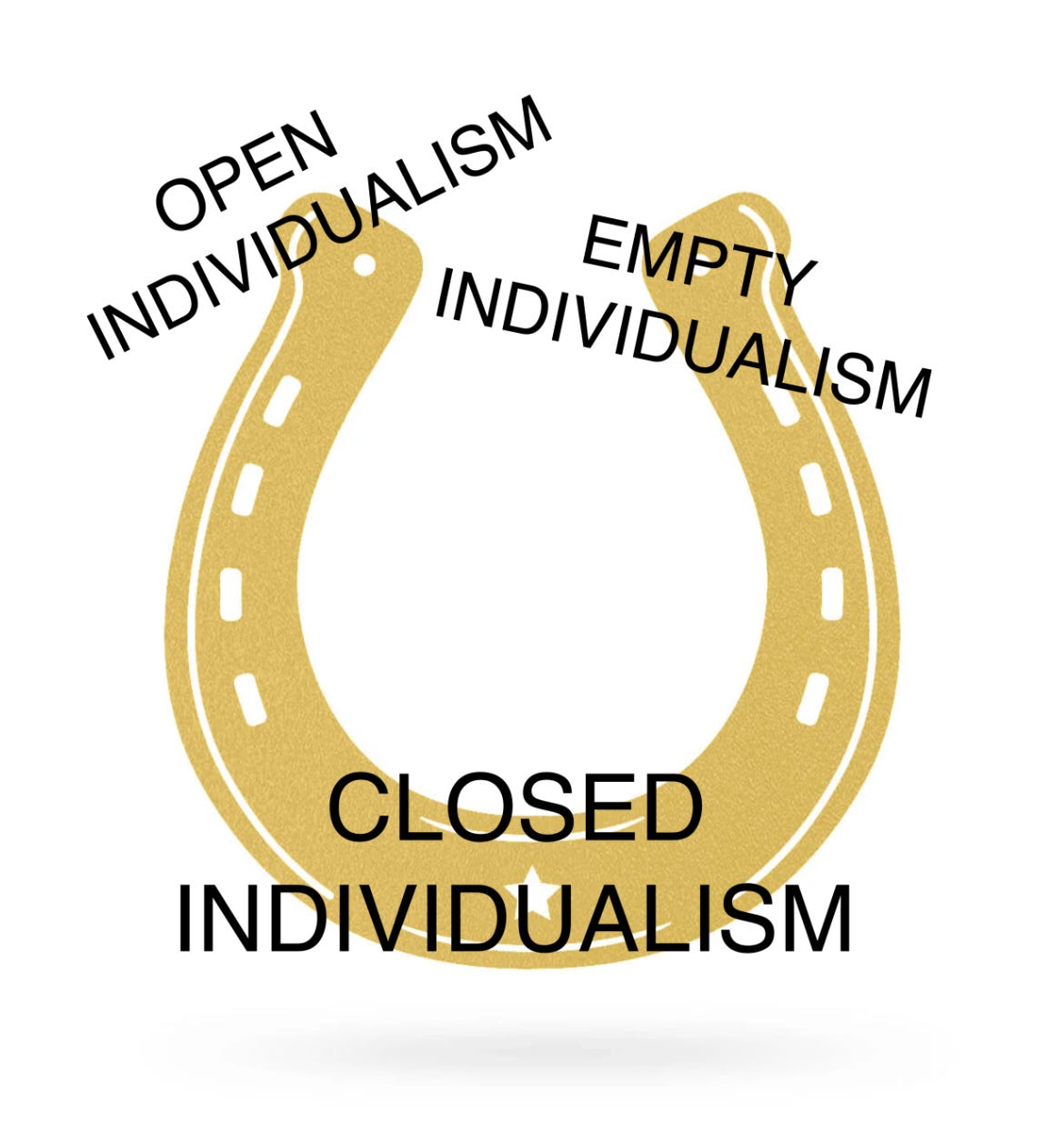
Closed Individualism
What is there even to say, about closed individualism? It is normal. It is boring. It is the default view that everyone grows up with, the view that everyone is left with if they don’t go out of their way to find another99 Or, I suppose, get smacked in the face with mystical insight through no fault of their own, or inadvertently stumble into a philosophical argument they end up taking seriously.. Few people will advertise themselves as closed individualists—what’s the point in bothering, when your view is the same one any random person will have?
You are you. You are still you when you grow up more. You don’t stop being you just because you had a quarter-life crisis or experienced “ego death” on a psychedelic or something. You have some nebulous thing sometimes called “continuity of consciousness”, and this thing persists when you sleep despite sleep interrupting consciousness in a sense. Your theory of identity is not especially robust to person-duplication devices or mind uploading being invented, but that’s okay, you can cross that bridge when you come to it. Any sense in which you exist as a sentient being after death is pretty much entirely poetic—and the poetic senses aren’t nothing, but y’know, they’re not everything either.
And really, I think that’s kind of a fine place to be? That’s where I am, for now, for the most part. It’s not flawless. It feels sorta suggestive of Cartesian duality, which is not quite an accurate worldview—we are not souls detached from the world, we are embedded agents, patterns physically implemented on brains, and these physical patterns are not separated by any ultimate Cartesian boundaries from the rest of the Universe. But like, meh? The normal ontology is sensible enough. And it’s not like it’s factually incorrect to draw the boundaries of your identity boundary there, nor does it seem to me that the seams here are so shallow it’s idiotic to cleave reality here. I think the best approach may be to try to patch it instead of radically diverging from it.
I recognize that
But like, meh? The normal ontology is sensible enough.
might be an argument that skeptics do not find spectacularly compelling. And I do not, to be clear, especially want to discourage exploring and taking seriously and maybe spending some time trying to alieve other views.
But at the end of the day, if closed individualism feels like the most grounded and reasonable view to you, it is perfectly okay to go back to that, I think, quibbles about Cartesian duality and the like notwithstanding? You don’t need to have a perfect solution to philosophy of self. Certainly I would love to have one someday, but we don’t, and I’m not very sure open individualism or empty individualism really fix that, and it’s okay to just accept a basic workable-if-imperfect framing provisionally.
In In Perfect Light, mercury says
A (…) common line is that death is bad because it deprives the moral balance of the universe of you, in particular, who are particularly valuable by virtue of being someone who has lived. No, people who could have lived but never did are not similarly valuable, shut up.
This is fascinating because ‘you’ are an abstraction to simplify property rights and smurf inclusive genetic fitness. If the ‘you’ of you is your property rights, then fine, you die when you die. For any other definition of you, you die many times before you die. If ‘you’ are your present experience, you die every instant. If ‘you’ are your dispositions, you die most often in childhood as your dispositions evolve rapidly, and you continue to die regularly throughout the rest of life. If ‘you’ are your memories, you die as you forget1010 I’m maybe willing to grant this one a little bit. But there’s a pretty large discontinuity of memory when you die for real. Maybe I could be convinced some forms of amnesia are more than halfway to death.. You also die as you add more memories unless you claim that ‘you’ are your earliest memory in particular, or that you only stop being you when you lose all the memories you currently have, which feels unprincipled but whatever.
And like, I don’t know man, I’m a human being. That’s the sort of thing I am, unless you want to identify “me”1111 I do see people say that “the part of you that calls itself ‘I’ is only a particular part of you that humans create for particular reasons.” I suppose Freud sorta does that. with the general algorithm currently running (I claim) on April’s brain that produces Apriiori blog posts and which might get partially absorbed into an LLM someday. But April is a human being, at any rate. I think my present experience and dispositions and memories are each of them a big important part of me, but I also think the fact that these things change over time is part of what makes me me. If you freeze me in amber, I guess that’s me in a sense, but I’m paused, I’m not being anymore.
Life is about becoming. And sure, you can call becomings deaths and rebirths if you want, but like—that’s a poetic viewpoint, and maybe an insightful poetic viewpoint, but I’m still the same person I was five years ago and I don’t really think that’s just some sort of property rights abstraction.
None of this post is meant to say much about plurality1212 Oh hey, they finally renamed the Wikipedia article!, which I think is a neat development in (folk) philosophy of self. And you’ll have to wait more if you want me to give a thorough opinion on Boltzmann brains, I’m still confused about those. I do have an official guess on anthropic immortality, though.
A note before we close:
My grandma has been in the hospital for about a week. We had a brief phone call today for what she seemed to think would be her last chance to talk to me—she said she was going to die today, and that she was very proud of me and would always love me. My dad isn’t sure how dire the situation really is medically, but says she is at peace with the life she’s lived and is ready to move on. He seems to think my grandma may not want to pursue further treatment even if the doctors think the situation could be recoverable, but he doesn’t seem entirely resigned yet, so I’m not very sure if I will get the chance to see her again. Either way, my family and I would appreciate prayers, if you’re the sort of person who does that sort of thing. Thank you.
by Apriiori
↩One may justify the name “empty individualism” through comparison with Buddhist śūnyatā, as the ideas seem thematically related (I claim).
↩A topology forms a T₁ space or is a Fréchet topology when, for any pair of two distinct points, each lies in some neighborhood which does not contain the other.
↩The obvious objection is that weird esoteric mystical terminology is incredibly fun. This is a very good objection.
The less obvious objection—or at least, the objection that is only obvious if you’re a rather specific sort of person—is that so-called “sanity promotion” can keep you trapped in psychological normalcy, when maybe psychological normalcy isn’t desirable. And, yeah, maybe. Reorienting your worldview can involve some loss of psychological stability, and yet crises of faith are important to have now and then. Buddhist types might argue that valuable profound and world shattering phenomenological insights can be had, and I’m not one to entirely dismiss them.
But then again, also maybe not. Pray for serenity and wisdom, not only for courage.
↩One assumes this is a similar notion of substance to that which sometimes comes up in Christian theology.
↩Did I choose this quote because I found the length of the name of its source funny? Yeah, that was probably part of it.
↩I PROMISE I’m not actively trying to offend you Celene I just do actually feel like this, cf. the second footnote. I wrote this post because I think people arguing for the normal sane stance sometimes is important, surely you can empathize with that motivation.
↩I extrapolate from a small n.
↩Or, I suppose, get smacked in the face with mystical insight through no fault of their own, or inadvertently stumble into a philosophical argument they end up taking seriously.
↩I’m maybe willing to grant this one a little bit. But there’s a pretty large discontinuity of memory when you die for real. Maybe I could be convinced some forms of amnesia are more than halfway to death.
↩I do see people say that “the part of you that calls itself ‘I’ is only a particular part of you that humans create for particular reasons.” I suppose Freud sorta does that.
↩Oh hey, they finally renamed the Wikipedia article!
↩