contra celene on mirrors and bread
sometimes i accidentally write too much
Celene recently posted an article regarding the Eucharist. As her girlfriend who was raised Roman Catholic and remains somewhat fond of Roman11 I have reservations about the common shortening to just “Catholic”. The Roman Catholic Church cannot make membership in a catholic church conditional on believing very specific points of dogma! I don’t want to call a church simply “Catholic” if it isn’t actually universal, and I’m not super inclined to count “well, we hope to convert everyone someday” as a legitimate attempt at universality. Catholicism despite my unfortunate22 According to some heretical3 inability to really see eye-to-eye with the Roman Catholic Church on matters like “Was Mary actually a virgin?4” and “Did Jesus return from the dead in a physical sense, as opposed to as a character that occasionally appeared in visions or as the mystical body of Christ?”, I am obviously obliged to reply.
Now, the Eucharist isn’t very scary, so it’s off theme for October. Thankfully, Celene also discussed Bloody Mary in her post. A perfect excuse.
Before we start: my ontology is, I think some would claim, a little gerrymandered in some ways? Personally, I think I endorse trying to engage with the culture I grew up in to the best of my ability, and often this involves interpreting religious claims as talking about some pretty nebulous and abstract entities—and I can totally see why someone would look at that and be like, “this is nonsense, what is the point in taking it seriously.” I can imagine even some religious people saying I’m being like, weird and relativistic about truth. I certainly wouldn’t say that I carefully adhere to the seams of reality, when I think about these things—often, I just try to refrain from doing very much cutting.
Mostly the point of bothering with any of this is that I enjoy doing it, which seems like a perfectly adequate reason. I’m pretty sure the worst case outcome is that I say some dumb or confused things in blog posts, which doesn’t sound like that big a deal. I also expect making honest efforts to engage with my childhood religion to be spiritually enriching, though that’s more because I have a peculiar sort of faith than because I have some thought out reason that I’d expect to be compelling to someone skeptical of the value in doing so.
Anyways, let’s begin.
Jesus was a real preacher who is dead, and is said to inhabit Heaven, which is, notably, not bread.
I object to the idea that Heaven is notably not bread. For example, consider the Lord’s Prayer, said in mass shortly prior to the Eucharist. There is a line commonly translated as
Give us this day our daily bread,
which probably shouldn’t be, because Communion is weekly for most Roman Catholics, not daily. But more importantly, the Greek word ἐπιούσιον probably did not mean anything remotely close to “daily”. It’s probably ἐπι- (upon, over, super) plus οὐσία (essence, substance.) The bread is not daily, it is supersubstantial. Quoth the Catechism:
“Daily” (epiousios) occurs nowhere else in the New Testament. Taken in a temporal sense, this word is a pedagogical repetition of “this day,” to confirm us in trust “without reservation.” Taken in the qualitative sense, it signifies what is necessary for life, and more broadly every good thing sufficient for subsistence. Taken literally (epi-ousios: “super-essential”), it refers directly to the Bread of Life, the Body of Christ, the “medicine of immortality,” without which we have no life within us. Finally in this connection, its heavenly meaning is evident: “this day” is the Day of the Lord, the day of the feast of the kingdom, anticipated in the Eucharist that is already the foretaste of the kingdom to come. For this reason it is fitting for the Eucharistic liturgy to be celebrated each day.
(…)
The Father in heaven urges us, as children of heaven, to ask for the bread of heaven. [Christ] himself is the bread who, sown in the Virgin, raised up in the flesh, kneaded in the Passion, baked in the oven of the tomb, reserved in churches, brought to altars, furnishes the faithful each day with food from heaven.
Now, I’m a little skeptical of some of the theology here (everyone except Roman Catholics has “no life within” them? Surely that’s a little much.) But the bread is definitely said to be like, of Heaven, or from Heaven, or something like that.
My local parish has on the wall the quote
The dwelling place of God is among mortals.
(or perhaps some rephrasing of the same idea). Now, that quote is from Revelation. You could maybe argue that the parish is taking it a little out of context. But I’m not taking it out of context, for the context I saw it in was that of a parish wall. And anyways, I am pretty sure it isn’t actually very heterodox to read Revelation as being an allegory for Rome and such rather than specifically as a prophecy about the end times, so nothing’s stopping me from using this to justify the position that God’s dwelling place is currently among mortals. The more than half55 Circa 2010, according to the Wikipedia article on the Second Coming, which cites Pew Research. of American Evangelicals who think Jesus is literally returning by 2050 are nuts and I don’t know quite what’s up with the 32% of American Catholics who think the same. I don’t think the Church teaches anything like that, where are you getting it from? It’s been two thousand years, why now? They can’t possibly be using Doomsday Paradox reasoning, right?
In the words of Luke (17:20-23):
Once Jesus was asked by the Pharisees when the kingdom of God was coming, and he answered, “The kingdom of God is not coming with things that can be observed; nor will they say, ‘Look, here it is!’ or ‘There it is!’ For, in fact, the kingdom of God is among you.”
Then he said to his disciples, “The time is coming when you will long to see one of the days of the Son of Man, but you will not see it. People will tell you, ‘There he is!’ or ‘Here he is!’ Do not go running off after them.”6
The Kingdom of God is basically the same thing as Heaven. Indeed, Matthew tends to use the phrase “the Kingdom of Heaven” for what seems to be the same theological concept.
Obviously it’s a little difficult to reach across a two thousand year gap. It would be foolish to assert with any certainty that I in particular understand Jesus, and that all my personal biases were exactly what he meant all along. But nonetheless, like, come on. It’s obvious what he’s getting at. The world is not going to end via intervention from the magic sky dimension in the next couple decades. Heaven can’t march down from the sky! The true Heaven has been inside us all along! Just like bread!
Anyways. Celene and I, and I think most of our readers, are skeptics of miracles77 Or like, I’m personally inclined to hedge a little—faith healing reportedly works sometimes, and I don’t personally object strongly to understanding faith healing through a spirituality-based ontology, but I do pretty confidently guess that a combination of luck and physicalist ontologies of the human mind and body will in principle suffice to explain any events that have happened—maybe they still count as miracles nonetheless, maybe not. But also I lack a spectacularly good model of how far exactly placebomancy can get you. So I dunno, maybe ישוע was an unbelievably impressive healer and exorcist, and maybe an accurate account of his works would shake the faith of a naïve atheist. Probably he didn’t walk on water or turn blood into wine, though.. So if God and Christ are to be worth talking about at all, obviously they can't just be like, off in Heaven, some alternate dimension in the clouds some people wake up in after they die. I’m pretty skeptical of the metaphysics where that’s what happens when you die! God must be here, with us, doing things! He has to be identified with some abstract object that actually interacts with our lives88 Or with, say, our Creator, but Azathoth kinda has that taken, and I don’t think either the historical preacher ישוע or the Biblical character of Jesus or the modern theological entity of Christ have ever especially been trying to talk about how we’re all children of Azathoth. We’re children of God in a somewhat different sense from how we're children of Azathoth. And clearly for any theology to be of much merit it must be talking about something which has at least some properties beyond, say, being an unmoved mover.
There’s also that view which equates the Second Coming with the Hyperobject at the End of Time, I guess..
Or if you prefer the words of the allegorical youth pastor:
Well, kids, do you know who else is among us?
So, I dunno, I don’t really think Jesus is off in Heaven—or alternatively, maybe I think Heaven can be bread, or that being in Heaven doesn't preclude being in bread. I’m not sure if Heaven is even the most common place that Jesus is said to be, anyways. Jesus is here with us if he’s anywhere. Everyone has the Buddha-nature; you can see Christ in anyone, for we are all of us children of God.
And really, in my heart of hearts, I do kinda feel like Christ is specifically in the bread?
Bloody Mary Bloody Mary
Before we discuss that feeling further, let us begin with Celene’s spookier99 I suppose the Eucharist can be spooky from a certain point of view. Fear of God used to be considered an important virtue, after all. But I mostly experience awe and love and such towards it, and those do seem like mostly the appropriate ones, even if I’m rarely one to condemn a wide emotional range (usually if there’s an issue it’s more with maturely responding to emotions than with feeling them in the first place.) point of comparison.
Bloody Mary is a spirit that humanity has been summoning for probably over a century and a half. The details of the ritual have varied. The most common form in the modern era is to stand in a dark room with a mirror, often a restroom, and chant her name three times (similarly to the ritual depicted in Beetlejuice.) After doing this, Mary will (sometimes, if you get the important parts right) appear in the mirror. Descriptions of her subsequent behavior vary, including in whether she leans benevolent or malevolent, though I imagine most of them to be somewhat exaggerated. She probably does not steal your soul—most of the spirits that can do that are new ones created by the mad engineers down by the Bay. Sometimes she’s said to be able to predict the future, though this is somewhat less common in more modern variants.
If the concept of Bloody Mary is new to you, you’re capable of taking it seriously, and you (importantly) aren’t in a mental state where a spooking is liable to do you substantial harm1010 If you are in such a mental state, Apriiori recommends trying to fix that by the thirty-first, or else avoiding Halloween festivities. Just watch Pixar’s Coco or something, that’s a wholesome movie., it is the considered opinion of Apriiori that trying to summon Bloody Mary for yourself can be an exciting Halloween activity. Apriiori is not liable for any mishaps that may occur as a result of attempted summonings or more generally as a result of being the kind of person to attempt a summoning at the joking1111 Or am I? suggestion of a disaster trans girl’s blog. If any readers attempt to summon Bloody Mary, whether now or after going through the Apriiori archive at some point in the future, we would be interested to hear more in the comments (regardless of whether the summoning is successful.) In particular, we would be interested in hearing if she is still willing to share predictions—it’s not totally clear to me why she would be any less capable of making them now than she was a century ago—especially if you can tell us about any predictions that are either concrete enough to try to start keeping track of a predictive record1212 The Catechism only forbids practices falsely supposed to unveil the future, so if she just makes good predictions then that is acceptable. or confusing enough to be deeply fascinating.
If you plan to try to summon her, consider before continuing to read whether you are a sufficiently accomplished rationalist that your spirit-summoning will be unimpeded by discussion of the ontological status of the spirit in question—but if you plan to look no further, consider before ceasing to read whether a spirit who you’d fail to summon for that reason was really worth summoning in the first place1313 I am generally partial to “not especially”, on this question, but that’s just me..
Anyways. Celene thinks Bloody Mary isn’t in the mirror.
“Bloody Mary is in the mirror”.
Is this true? Well, it’s arguable, but to me, it seems less true than the [analogous] Loch Ness claim.
Again, we consult Google AI Overview, who agrees with my entirely vibes based assessment.
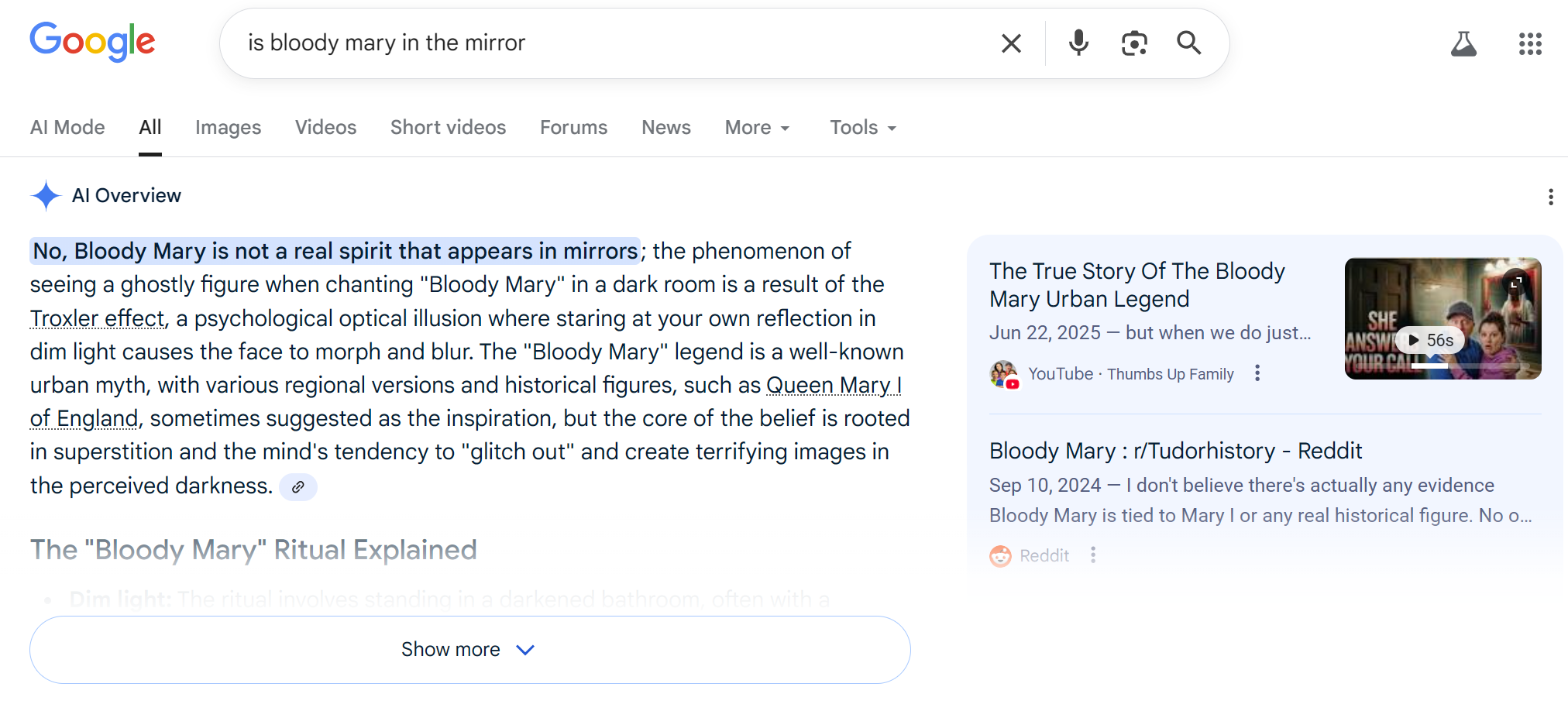
Well. If I read that AI Overview closely, the main objection it appears to be making is that Bloody Mary is “not a real spirit” (whatever that means), and that she’s located in the perceived1414 …perceived? As opposed to actual? Surely it’s not merely perceived… darkness, rather than in the mirror. This seems to me like a silly contention to base an argument on.
And I submit for additional consideration:
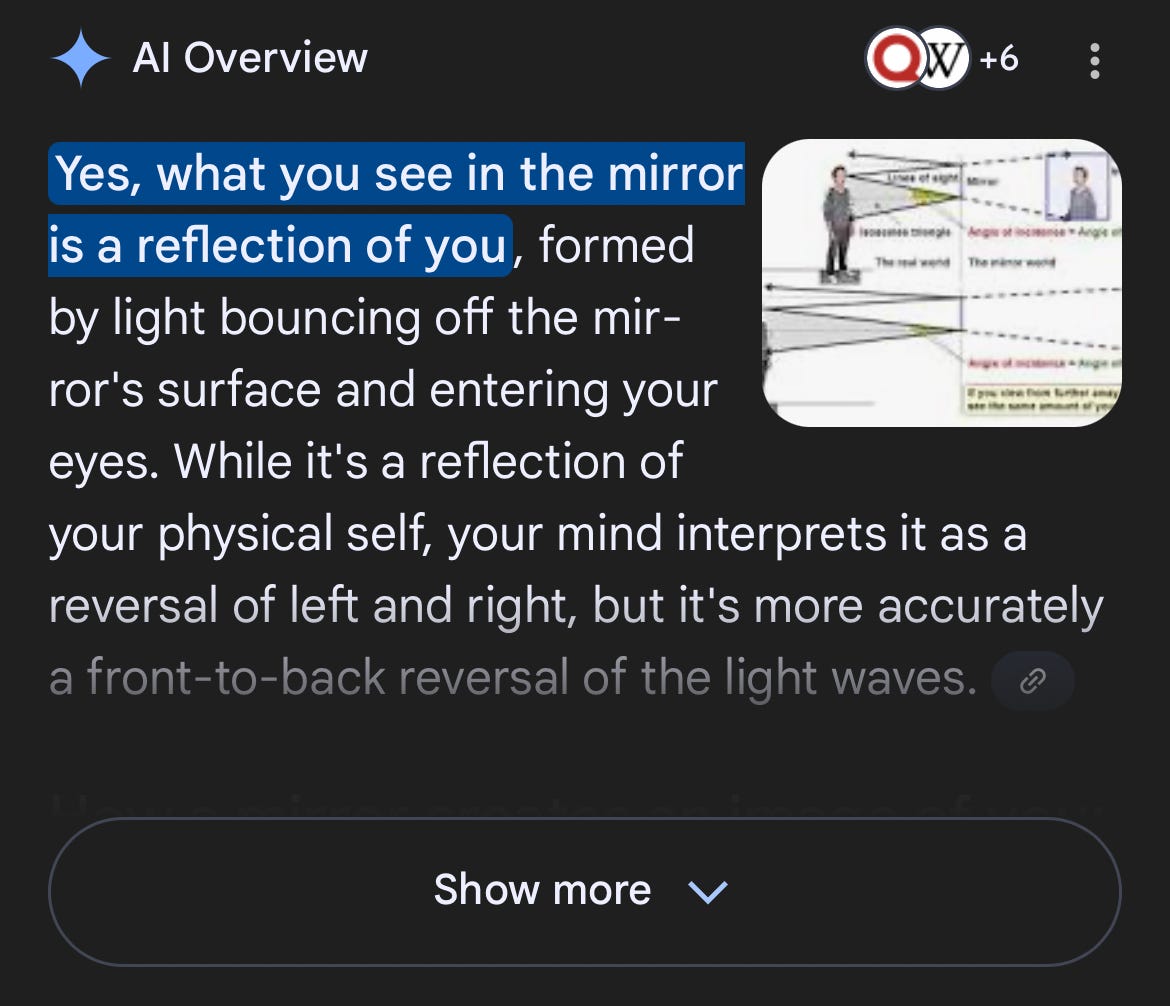
Your reflection, Google’s Overview AI seems to agree, is in the mirror. And it is a very common and reasonably obvious guess that the reflections in the dark room’s mirror are part of what contribute to seeing Bloody Mary—Celene’s AI Overview calls this the Troxler effect, so I guess it’s a known phenomenon. If Bloody Mary is largely made of reflections, and reflections are in the mirror… then surely it makes sense to say that Bloody Mary is in the mirror? I think Bloody Mary’s in the mirror.
I actually think I have the opposite intuition from Celene. I feel like it makes more sense to say Bloody Mary is in a mirror than it does to say that the Loch Ness Monster is in Loch Ness. Nessie is, I put forth, a basically mundane physical animal with a long neck and possibly with humps that is native to Loch Ness—if she in fact exists. If you go to Loch Ness, and you bring whatever equipment would be necessary for you to correctly identify whether it contains such an animal, I predict that you will not find Nessie. Nessie is not in Loch Ness, and in fact does not exist.
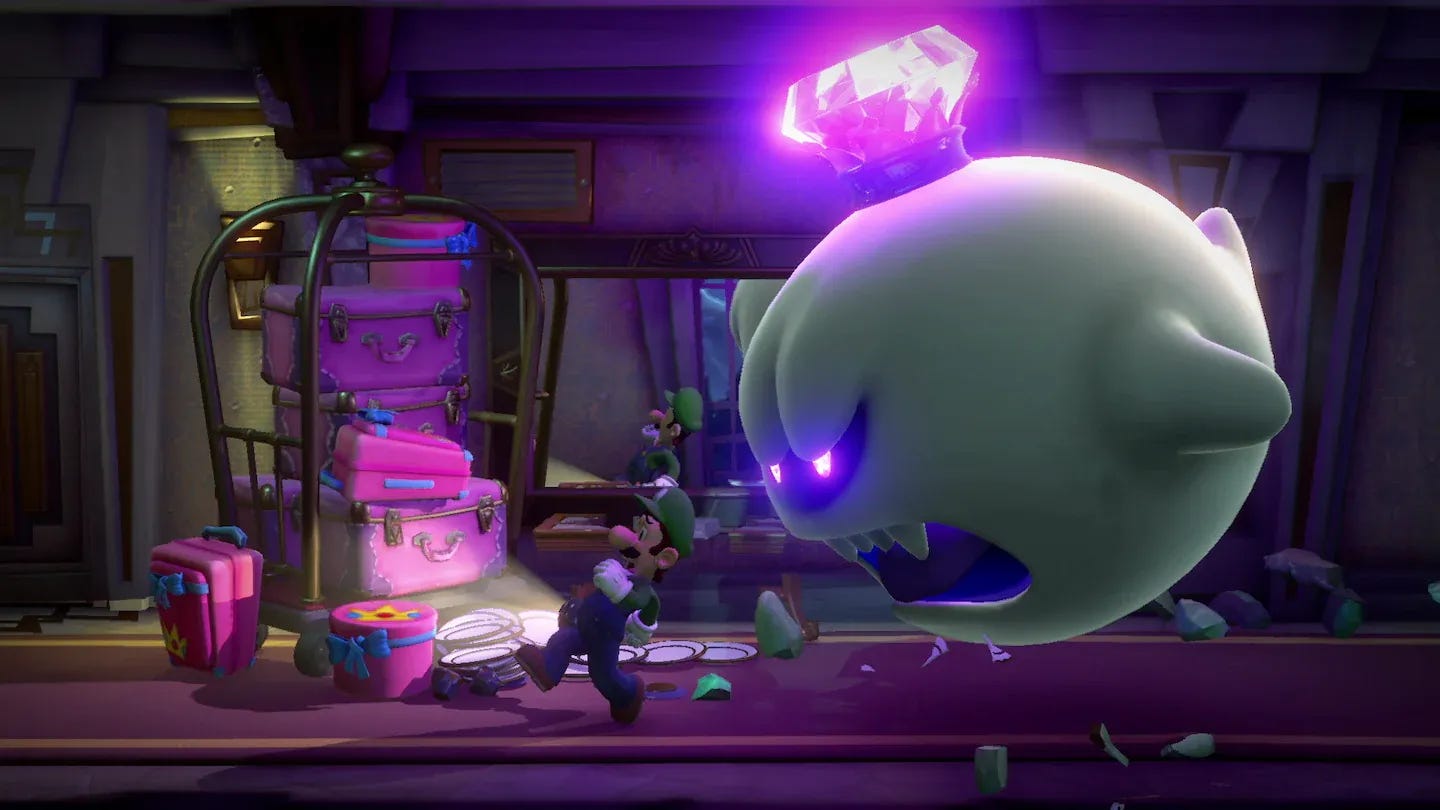
On the other hand, suppose you do the ritual to summon Bloody Mary, and then you see what seems like a spooky face in the mirror. Personally, I’d say that you’re seeing Bloody Mary in that mirror. I don’t think it’s like Nessie, where Nessie is like, a relatively concrete sort of creature in the grand scheme of things, an animal mostly like any other animal you've seen before, where it just like, doesn’t exist. Bloody Mary is a spirit. What’s up with spirits is controversial1515 Citation needed, but I think the position that they aren’t exactly physical entities like the ghosts from Luigi’s Mansion isn’t too unusual a take. I certainly believe in Zeitgeister, but a Zeitgeist1616 Much like, I would claim, the Holy Spirit, though that’s born somewhat out of skepticism about Pentecost and such and maybe isn’t a totally orthodox stance. isn’t exactly a concrete being that you can encounter the way you’d encounter a dog or a weasel. The time spirit is an abstract vibe, or a pattern in human behavior, or whatever.
Now like, admittedly, Bloody Mary is a little more concrete than a Zeitgeist. She’s that thing, in the mirror! You can point at her! She’s right there! And maybe you have some standard for what would count as a “real spirit” which Bloody Mary fails to pass, and this test is applicable to mirror apparitions but isn't as applicable to or otherwise fails to rule out time spirits. For example, maybe you think Zeitgeister sort of stay around if people stop believing in them, even though they might be altered to some degree, but you think Bloody Mary would pretty much just stop existing if people stopped believing in her1717 I might contest this? I feel like the mirror spirit ritual might be rediscovered from first principles eventually. But if your position was that the rediscovered thing would be a separate spirit and no longer meaningfully be Bloody Mary, sure, fine.
Also I think this test is sort of bad? For example, it marks cooperate-cooperate equilibria as not being real. I think that’s dumb, cooperate-cooperate equilibria are very real, and it is good to have the specific sort of faith that’s required to bring them about (without getting hurt too much in the process).
But bad or not, it is certainly well-known..
In that case, fine, I guess saying she’s in the mirror is merely similarly correct to saying Nessie’s in Loch Ness, rather than being more correct. Or like, she’s not currently in my mirror as I type this, but maybe if I went and tried to summon her I’d catch a glimpse of her, and then she would be. But that’s besides the point.
Take this, all of you, and eat of it
Okay, so, when I say I feel like Christ’s in the bread, I don’t mean that I especially believe Eucharistic miracles have ever really involved actual heart tissue. I think almost certainly something else was going on there, though I don’t specifically know what. I do not think any amount of investigation you throw at the physical bread is going to reveal anything unusual going on—and the Roman Catholic Church, though it judges some supposed Eucharistic miracles as worthy of belief, does not particularly teach that investigation of the bread will find anything strange. Anything observable in such a way is merely the “accident”, rather than the “substance”, which is the part they teach is transformed into the Body and Blood of Christ.
But like, I think eating God is pretty great. Especially the way Christians I grew up around thought and spoke about it, eating God always seemed like a remarkably wholesome mystical activity. I can absolutely see why the Church would center its weekly spiritual service around it. God becomes part of you, because you are what you eat. It helps nourish your spirit, worn down by the world, for the week ahead. It’s a remarkably intimate thing! I think it’s awesome, and it’s a ritual I’m glad to have grown up with.
As I understand it, Protestants generally maintain that the bread symbolizes the Body of Christ. And if someone wanted to argue that I essentially agree with the Protestants on that one, then maybe they might have a good point? I don’t know, the whole substance idea is very strange and unintuitive to me. Studying mathematics turned me into a structuralist—I don’t really know what it means, to say that the substance of the bread is transformed, aside from the in-principle observable effects thereof.
But I would contend that the way I feel about the Eucharist is appreciably different from regarding it as just a symbol? Like, participating in Communion does very much tend to be good for my soul. And, sure, it’s a little entangled with the impact of everything else that goes on in a mass, probably plenty of other rituals could achieve a pretty similar effect on my mood in principle (though having grown up with something from childhood does help), it’s not like the Eucharist is the only thing that can ever fill me with that sort of ἀγάπη.
But really, it’s remarkably impactful! It’s not, like, as psychoactive as a drug, but the things I was taught about how it nourishes the spirit do not strike me as incorrect. They seem to me to be basically true. And yeah, I don’t know if I agree with your average Roman Catholic or with the Church on exactly what’s going on, I think I consider much more of what’s going on to be based on general principles that are not inherently exclusive to Christianity, and it seems to me that everything which happens can be explained in terms of reasonably straightforward psychological dynamics that make perfect sense in a wholly naturalistic understanding of the world.
But like, I don’t really think that diminishes the spiritual meaning of any of it! So what if spirituality is mostly something implemented on the human mind and heart, in the patterns of information that make up our very selves, instead of on… some weird supernatural thing totally external to our Universe and not composed of it in any way, I guess?
Christ1818 That is, the entity which the ancient preacher ישוע is commonly held to be an incarnation of., to the extent one allows such a thing into a generally physicalist ontology—and even if I don’t think physicalist ontology is immune to crisis, it does seem like the sturdiest rock we have available to try to build on—is some abstract mystical divine entity. I don’t really have a full theory of the nature of “the divine” which I’m happy with, but it has something to do with patterns in the human heart and mind, and patterns in interactions between people, and patterns in the mathematical structure of our Universe, and so on.
And I don’t think there’s anything especially wrong with regarding abstract mystical entities as located in bread1919 I might take issue with the idea that Christ is only in the bread. Omnipresence makes a little more sense to me as a property to assign to an abstract mystical entity than omnipotence or omniscience do. But I don’t take issue with the idea that “the mode of Christ’s presence under the Eucharistic species is unique”, this feels like a reasonable attitude.—that isn't one of the parts of orthodoxy that I personally take any issue with, though I would not mind if they cleared up some of the philosophy around the specific sense in which they hold Christ to be in the bread. Possibly they would end up clarifying their stance into a position which I didn’t feel I could conscionably claim to agree with or at least be open to, which would be a little unfortunate for my prospects at honestly participating in Communion. But I could live with that, if it were the cost of clarity. As is, though, I do not feel like adopting the internal posture I was taught as a child regarding the Eucharist actually necessitates believing any concrete claims I feel unable to accept2020 I can only hope and pray that, should some less heterodox take on God than mine be accurate, he can see that I am really trying my best here!. Sure, Christ is in the bread—why wouldn’t he be2121 The Church does teach that Christ is in the bread in a way that does not depend on the inner beliefs of the priest or recipients—but that faith may be necessary for receiving the benefits. I am a little confounded by the idea that perhaps, if not one person at the mass has any faith, Christ is present but… causally inert? This mostly seems tantamount to being no more present in the bread than anywhere else.?
Further Contentions
Celene said to me:
my actual claim is that it’s more acceptable to use imprecise language when your beliefs are not in question
like no one expects someone to believe in the loch ness monster
but lots of people are christians.
And yeah, I suppose that’s a pretty sensible principle. Indeed I think it is more likely that someone who says “Jesus is in the bread” generated that statement using a flawed world model than someone who says “Nessie lives in Loch Ness”, and so it’s maybe more important to be explicit about what you think of the bread than to be explicit about what you think of Nessie.
1a3orn:
ok but just take the analytic philosophy symbolic logic pill: “All Jesuses are in the Eucharist”
ez pz
Personally, I feel like this is a copout. I wouldn’t really want to give a straight “no” as my answer to the question “do any Jesuses exist?” I do not really think that like, Jesus Christ is some simple unambiguously defined entity—but like, if someone has a slightly mystical experience of encountering Christ through prayer, I would say that there is in fact a thing which they encountered, and probably it makes sense to say that that thing is “a Jesus”. And sometimes those are in nature or in a homeless person or whatnot, rather than in the Eucharist.
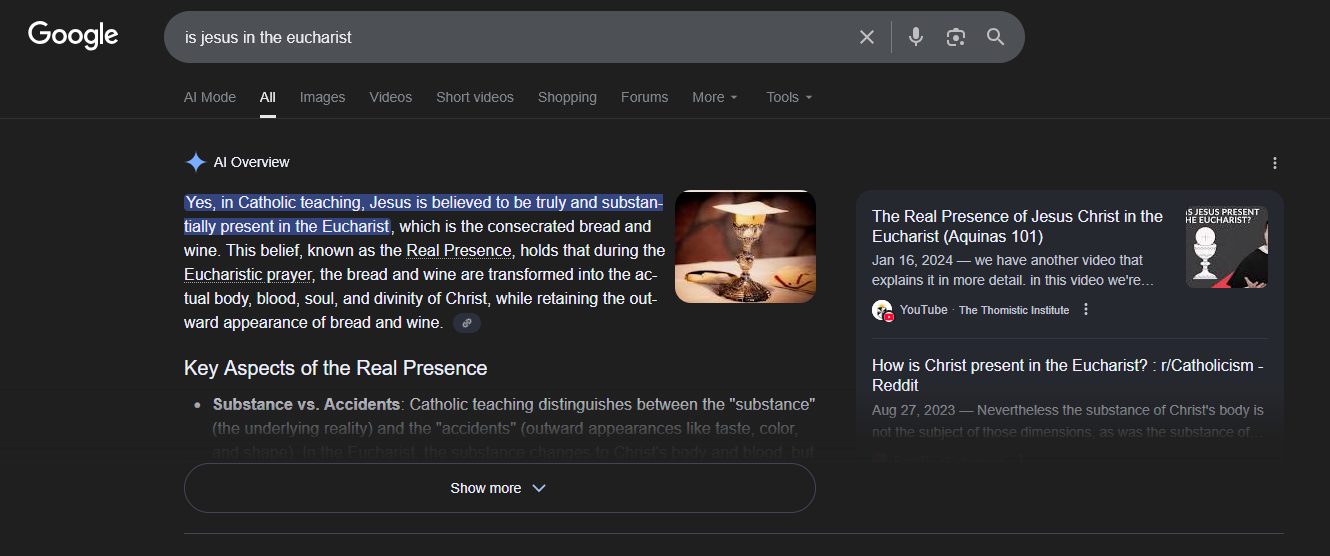
Also, if we’re treating AI Overview as an authority:
Anyways, I’m gonna go mix some tomato juice and vodka. Chao!
I have reservations about the common shortening to just “Catholic”. The Roman Catholic Church cannot make membership in a catholic church conditional on believing very specific points of dogma! I don’t want to call a church simply “Catholic” if it isn’t actually universal, and I’m not super inclined to count “well, we hope to convert everyone someday” as a legitimate attempt at universality.
↩According to some
↩I do hope I am acting in sufficiently good faith for it to merely be material heresy rather than formal heresy. I don’t know how I would act, if I wished to believe true things, while not risking seeming obstinate to someone convinced of inaccurate dogma. Hopefully trying to be open-minded is enough, though perhaps I don’t have quite as much of that virtue as Scott Alexander:
I will admit my bias: I hope the visions of Fatima were untrue, and therefore I must also hope the Miracle of the Sun was a fake. But I’ll also admit this: at times when doing this research, I was genuinely scared and confused. If at this point you’re also scared and confused, then I’ve done my job as a writer and successfully presented the key insight of Rationalism: “It ain’t a true crisis of faith unless it could go either way”.
Personally I don’t know if I’d call it fake, but I do appreciate that it doesn’t seem to have the sort of explanation that is indicative of anyone receiving eternal torment!
↩Does it detract from the story of ישוע in any way if he came not just from a manger, but from a sexual assault or something similarly disgraceful—is it unthinkable that the messiah could be something so lowly as a bastard?
I doubt this is actually very much how the Church—at least for many of its wiser members—thinks of it today. A lot of them seem to get the “the first shall be last and the last shall be first” thing, they could totally be willing to worship an illegitimate child. But like, I dunno, it seems to me that the myths stem in part from an attitude that kings—Zoroastrian magi? No, we’re calling them kings—had to bow before Jesus as a baby or else he wasn’t a worthy messiah-God, an attitude that without a magical explanation for his premarital conception the idea of honoring him was too affronting.
And personally, I’d rather walk back some of that apparent distortion. My best guess is that it is false, and I feel that it honors ישוע much more and is more in line with his teachings to believe true things about his lowly origins and respect him just as much regardless. In the words of Eliezer Yudkowsky:
But I do not wish to condemn a man who is not truly so guilty. What if Jesus—no, let’s pronounce his name correctly: Yeishu—what if Yeishu of Nazareth never walked on water, and nonetheless defied the church of Judea established by the powers of Rome?
Would that not deserve greater honor than that which adheres to Jesus Christ, who was only a mere messiah?
(…)
I severely doubt that Yeishu ever spoke the Sermon on the Mount. Nonetheless, Yeishu deserves honor. He deserves more honor than the Christians would grant him.
(I don’t have a strong opinion on the exact provenance of the Sermon on the Mount or other Q source material, though it seems unlikely it’s a word-for-word transcription of any specific sermon.)
↩Circa 2010, according to the Wikipedia article on the Second Coming, which cites Pew Research.
↩Jesus then proceeds to immediately talk about the rapture.
“It will be just like this on the day the Son of Man is revealed. On that day no one who is on the housetop, with possessions inside, should go down to get them. Likewise, no one in the field should go back for anything. Remember Lot’s wife! Whoever tries to keep their life will lose it, and whoever loses their life will preserve it. I tell you, on that night two people will be in one bed; one will be taken and the other left. Two women will be grinding grain together; one will be taken and the other left.”
So. I don’t know. Maybe that’s all meant literally and the rapture believers are indeed understanding the teachings pretty accurately and Jesus was (it seems to me) wrong about all that, or maybe he said this part only to his disciples because he expected them to less greatly misunderstand his esoteric metaphors about how clinging to material goods or even to your life can prevent you from achieving stream entry. I do like that reading, but my appreciation has little to do with the most likely beliefs of some first century Jews (and Greeks—Luke was probably a gentile).
↩Or like, I’m personally inclined to hedge a little—faith healing reportedly works sometimes, and I don’t personally object strongly to understanding faith healing through a spirituality-based ontology, but I do pretty confidently guess that a combination of luck and physicalist ontologies of the human mind and body will in principle suffice to explain any events that have happened—maybe they still count as miracles nonetheless, maybe not. But also I lack a spectacularly good model of how far exactly placebomancy can get you. So I dunno, maybe ישוע was an unbelievably impressive healer and exorcist, and maybe an accurate account of his works would shake the faith of a naïve atheist. Probably he didn’t walk on water or turn blood into wine, though.
↩Or with, say, our Creator, but Azathoth kinda has that taken, and I don’t think either the historical preacher ישוע or the Biblical character of Jesus or the modern theological entity of Christ have ever especially been trying to talk about how we’re all children of Azathoth. We’re children of God in a somewhat different sense from how we're children of Azathoth. And clearly for any theology to be of much merit it must be talking about something which has at least some properties beyond, say, being an unmoved mover.
There’s also that view which equates the Second Coming with the Hyperobject at the End of Time, I guess.
↩I suppose the Eucharist can be spooky from a certain point of view. Fear of God used to be considered an important virtue, after all. But I mostly experience awe and love and such towards it, and those do seem like mostly the appropriate ones, even if I’m rarely one to condemn a wide emotional range (usually if there’s an issue it’s more with maturely responding to emotions than with feeling them in the first place.)
↩If you are in such a mental state, Apriiori recommends trying to fix that by the thirty-first, or else avoiding Halloween festivities. Just watch Pixar’s Coco or something, that’s a wholesome movie.
↩Or am I?
↩The Catechism only forbids practices falsely supposed to unveil the future, so if she just makes good predictions then that is acceptable.
↩I am generally partial to “not especially”, on this question, but that’s just me.
↩…perceived? As opposed to actual? Surely it’s not merely perceived…
↩Citation needed
↩Much like, I would claim, the Holy Spirit, though that’s born somewhat out of skepticism about Pentecost and such and maybe isn’t a totally orthodox stance.
↩I might contest this? I feel like the mirror spirit ritual might be rediscovered from first principles eventually. But if your position was that the rediscovered thing would be a separate spirit and no longer meaningfully be Bloody Mary, sure, fine.
Also I think this test is sort of bad? For example, it marks cooperate-cooperate equilibria as not being real. I think that’s dumb, cooperate-cooperate equilibria are very real, and it is good to have the specific sort of faith that’s required to bring them about (without getting hurt too much in the process).
But bad or not, it is certainly well-known.
↩That is, the entity which the ancient preacher ישוע is commonly held to be an incarnation of.
↩I might take issue with the idea that Christ is only in the bread. Omnipresence makes a little more sense to me as a property to assign to an abstract mystical entity than omnipotence or omniscience do. But I don’t take issue with the idea that “the mode of Christ’s presence under the Eucharistic species is unique”, this feels like a reasonable attitude.
↩I can only hope and pray that, should some less heterodox take on God than mine be accurate, he can see that I am really trying my best here!
↩The Church does teach that Christ is in the bread in a way that does not depend on the inner beliefs of the priest or recipients—but that faith may be necessary for receiving the benefits. I am a little confounded by the idea that perhaps, if not one person at the mass has any faith, Christ is present but… causally inert? This mostly seems tantamount to being no more present in the bread than anywhere else.
↩