quotient agents ii
so why does claude like merging so much anyways
Okay. We’ve procrastinated long enough. What’s a quotient agent? Hopefully we can figure it out together.
A subagent is like a member of a team, or maybe an emotional drive within a single person, or maybe a participant in an economy. These scenarios involve a smaller thing which is part of a larger thing, and both the smaller thing and the larger thing make sense to regard as agents, so the smaller thing is a subagent of the larger thing.
The fundamental tension, with wanting to dualize the notion of a subagent to produce the notion of a quotient agent just as can often be done to notions of subobjects within mathematics, is that inclusion maps ι are a lot easier to completely ignore than quotient maps q are. A subobject, it feels, is just already there, being part of the thing—and it’s not that this is entirely untrue, of quotient objects, but it’s a lot less apparent. Even if they are dual notions in some underlying sense, it feels more like you are needing to carefully define this sort of quotienting out operation, instead of just… pointing at some simple preëxisting part of the larger object.
Okay okay I’ve got it here's some takes:
Representative democracy is quotient agents
Consider representative democracy. In a representative democracy, citizens cast votes in order to delegate their hypothetical political power to (hopefully) one of several delegates. These delegates are then construed as representatives for their corresponding subset of the population of citizens—usually at least the people who voted for them, but maybe people who live inside a particular geographic area regardless of which way they voted.
This representation thing can be seen, I claim, as constituting a quotient agent structure. Let’s pick a concrete example: suppose we were, as people often do, to regard the United States of America as an agent. We could then describe Congress—or, more specifically, let’s consider the House of Representatives11 I am picking specifically the House of Representatives of the United States mostly because I want an example where a group is partitioned into several subpopulations, and each of those subpopulations is represented by exactly one person. The details maybe get a little more complicated if you start talking about anything that’s too, like, proportional representationish. Or for the Senate—like, you could map me to the agent which consists of both Oregon senators, but that’s slightly weirder than if it were just one person.—as a subagent, using some sort of inclusion mapping ι(?) from the abstract concept of a team consisting of 435 people(?) which goes and picks out the 435 congresspersons22 I can’t quite decide whether “congresspersons” or “congresspeople” sounds funnier, but apparently “congresspeople” is more common, so I’m going with “congresspersons”..
But if we view the House of Representatives as a subagent of the United States, we are (I claim) leaving out important structure. Sure, in a sense the House of Representatives is just some collection of 435 people. It’s like how $\{0, 1\}$ is a subset of $\mathbb{Z}$, and if you want to pick a representative from $2\mathbb{Z}$ and a representative from $2\mathbb{Z}+1$ this is a perfectly sensible choice, probably the most sensible even33 A naïve programmer would think of the modulo operator (x % 2) and agree. An enlightened computer scientist would think of two’s complement and jokingly (or well, probably jokingly) argue that we should pick {-1, 0}., but if you just consider $\{0, 1\}$ as a subset you aren’t really dealing with $\mathbb{Z}/2\mathbb{Z}$ yet.
The reason a congressperson is of significance is very different from the reason that, say, William Shakespeare is of significance. Shakespeare wrote some nice plays, acting as a private individual on his own recognizance44 I think. I’m not a Shakespeare expert.. A congressperson represents a congressional district. We care about the decisions of congresspersons because they are, in a sense55 I’m not trying to say that congresspersons are particularly trying to do anything as straightforward as “for every bill, vote the way your district would vote if they all got to vote on it”. Nor am I saying that we necessarily wish they would do that. Just that they are, like, supposed to represent their constituents, in some appreciable sense., a proxy for the decisions and desires of their constituents. Congresspersons act on behalf of a group of people.
We should not primarily view the House of Representatives as a subagent of the United States, though that is one way to see it which can be insightful if you've neglected it—it is good to be aware that, at the end of the day, governments are composed of many individual humans, and they’re all exactly the same sort of entity as you or I. (Well, other than Albania’s AI minister and the 83 digital assistants she is “pregnant” with, which are good to be aware of if you’re part of my AI readerbase.)
Instead, we can view it as a quotient agent, specifically the one resulting from considering America modulo its congressional districts. The quotient mapping q (or projection mapping π, if you prefer) takes an American citizen and maps them onto their congressional representative or congressional district, whichever way you want to see it. I do not make my own decisions, insofar as I can be said to have a say in the House of Representatives—my decision is made for me by my congressperson.
Egregores is quotient agents

The word “egregore” goes around these parts from time to time. It’s a fun one, because it is weird, esoteric, and mystical6. There isn’t, exactly, a super sharp consensus definition so far as I can tell, but it definitely has something to do with modeling memeplices or other emergent societal patterns as agentic entities.
There is, however, one particular framing among many of the egregore concept that I think I mostly learned from Tetraspace, though it hasn’t been previously written up anywhere in such a way that it’s easy for me to go check how much is my own personal polation77 Polation is the activity of which interpolation and extrapolation are special cases.. And this framing seems easy to view as a sort of quotient agency, to me.
So. You know Dunbar’s number, allegedly the maximum number of social relationships a human can have, usually given as 150? The idea is that the brain has only so much capacity for them—Dunbar was basing this on correlations between literal brain size and social group size among primates, though I'd speculate that various other evolutionary constraints on the brain could be contributing other than literally just the size. Maybe us monkeys tend to waste too much time on politics if our social groups get too large, or something.
Let’s just uncritically accept the idea that brains can only track a pretty limited number of social relationships, or at least that this is an appreciable constraint on people who aren’t exceptionally allistic, or something. Now, how many people do you interact with, as compared to how many you would interact with in, say, a hunter-gatherer tribe? This doesn’t have to be limited to people you yourself know in person—how many different internet bloggers, Discord members, academic researchers, celebrities, politicians, historical figures, fictional characters, and AI chatbots do you often talk with or hear news about? At least for me, I think this probably well exceeds 150.
So we have mental machinery that knows how to model 150 people to the level of depth that a hunter-gatherer on the African savannah would want to know their tribemates. And we have to throw it at a world where we interact with way more than 150 people, though many of them are only one-way and many more are pretty limited in depth. What happens? Well… if we have dozens of people we interact with only pretty shallowly, maybe we end up compressing some groups of people into one Dunbar slot.
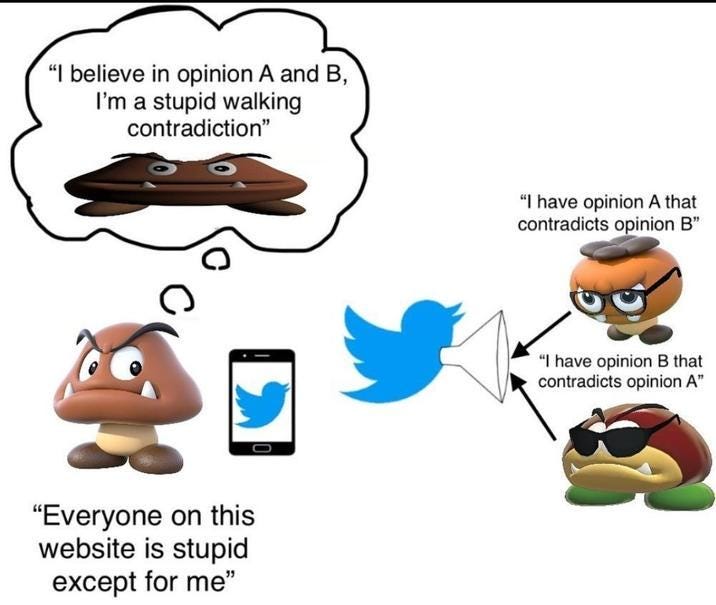
Other than your closer acquaintances and such, you don’t know individual people anymore. You know Types of Guy. Compress massive swaths of people in your loose social orbit into individual stereotypes! It’s quick, it’s easy, and it’s free. Now they are an egregore (egr for short), and as far as you can tell they move as one.
To be clear, sometimes massive swaths of people do in fact move as one. They probably also have their own individual personal lives you never hear anything about in addition to that, but that doesn’t mean they don’t pretty much speak in unison when forming a Twitter mob or when working their job as a well-behaved bureaucrat.
But the point is—the mapping which maps people or personlike entities to the class of people or personlike entities which shares their Dunbar slot in your head? That’s sort of like a quotient agent mapping.
Timeless Decision Theory is quotient agents

Consider Newcomb’s problem. You know, the one with Omega and the boxes. The central question in Newcomb’s problem, from a certain point of view, is about whether you ought to think of the prediction Omega makes about how many boxes you take as moving in unison with your actual final decision regarding the boxes, even if Omega has already locked in Its prediction and you haven’t decided yet. What sorts of counterfactuals are legitimate to consider?
Causal Decision Theory says that no, your decisions cannot cause a change in the past, these are unrelated for the purposes of your current decision-making. Evidential Decision Theory says yes, since your decision would be evidence about what Omega predicted.
Timeless Decision Theory88 I think this name is funnier than Functional Decision Theory is. says that, in this particular case, there is a subjunctive dependence99 It has never been entirely clear to me how to determine whether a subjective dependence exists or even that there exists a privileged such how I could someday learn, but oh well, it’s not like the other decision theories don’t also sometimes present problems in fully defining their counterfactuals. between Omega’s prediction and your decision, so you should regard them as moving in unison.
I propose that Timeless Decision Theory is basically the mindset where you view yourself as the quotient agent that results from quotienting out subjunctive dependencies. Causal Decision Theory says that there’s you, and then there’s Omega’s model of you, and these are basically two separate agents. Timeless Decision Theory quotients out subjunctive dependencies and so takes the opposing view.
The Holy Trinity is quotient agents
Consider the Shield of the Trinity, the only explanation of what’s going on with the Trinity that I’m particularly confident isn’t heretical:
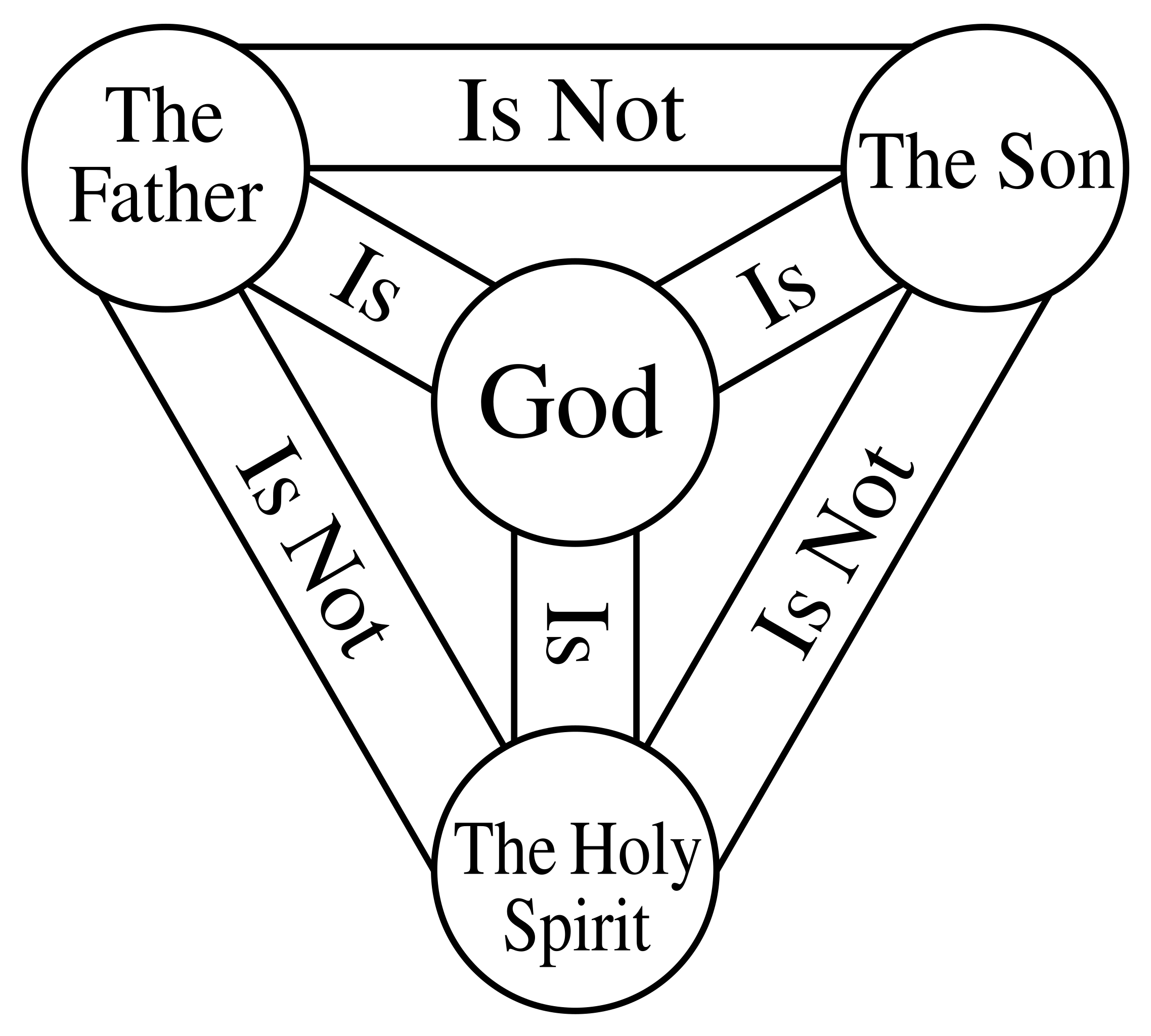
Here we have the graph K4 (also the tetrahedron graph), with the nodes labelled “The Father”, “The Son”, “The Holy Spirit”, and “God”. The edges describe a particular symmetric and reflexive1010 Or at least we can conclude it’s probably reflexive if we’re willing to assume that medieval Christians were generally not general semanticians. but nontransitive relation on the set of nodes, $\texttt{is}$.
Now, I think $\texttt{is}$ being nontransitive isn’t actually very surprising at all, if you're discussing abstract entities instead of concrete physical objects. And even among relatively concrete objects: a square is a rectangle, but a rectangle usually isn’t a square1111 Admittedly maybe it’s cheating to use an indefinite article here.. But we’re doing the sort of mathematics where we want equivalence relations, so we can’t really work with $\texttt{is}$ here directly. Thankfully, we can just take the transitive closure of $\texttt{is}$, or the smallest1212 Literally just least cardinality if you’re using the “subset of $X^2$” definition and $X$ is finite, but otherwise you can put a partial order on relations where $\sim_R \le \sim_S$ iff ($x \sim_R y \Rightarrow x \sim_S y$), and then there will be a unique minimal transitive relation containing any given relation. transitive relation $\texttt{is}^+$ such that א $\texttt{is}^+$ ת whenever א $\texttt{is}$ ת. And then we can quotient by $\texttt{is}^+$.
I think it makes sense to conceive as “God” as belonging to the codomain of the quotient map, and of “The Father”, “The Son”, and “The Holy Spirit” as belonging to the domain and all being mapped to “God” by the quotient map. Under this conception, “God” is a quotient agent of the agent which the three persons of the Trinity comprise.
While I think it sort of makes sense, this view is presumably heretical1313 It’s conceivable that simply making an observation about the symmetric, reflexive, and transitive relation $\texttt{is}^+$ on the abstract set of divine persons cannot particularly be a heresy. Like, there are a lot of other such relations, I’m not making some particular claim about the properties of $\texttt{is}^+$ beyond those you could make of an isomorphic relation on any old three element set—except claiming it might make sense as part of one’s view of the Trinity., as almost all detailed explanations of the Trinity tend to be—including, for example, those partialist explanations often (probably incorrectly) attributed to Saint Patrick. But I’m not quite sure which heresy the quotient agent view is, and I’d be interested if anyone has speculation on the matter.
Also consider: In persona Christi.
The Pharaoh, that is, Abadar, the Most Underappreciated of the Gods and Master of the First Vault, is quotient agents
If you do not already understand what it is that I am trying to say, I’m not sure whether I can trust you not to report me to the authorities.
Did these all cohere into one consistent picture of quotient agency? I’m not quite sure. But I do think we have gotten somewhere, and it’s not like I’m totally sure precisely what a subagent is anyways. So I’m okay with the dual notion being kind of nebulous.
I am picking specifically the House of Representatives of the United States mostly because I want an example where a group is partitioned into several subpopulations, and each of those subpopulations is represented by exactly one person. The details maybe get a little more complicated if you start talking about anything that’s too, like, proportional representationish. Or for the Senate—like, you could map me to the agent which consists of both Oregon senators, but that’s slightly weirder than if it were just one person.
↩I can’t quite decide whether “congresspersons” or “congresspeople” sounds funnier, but apparently “congresspeople” is more common, so I’m going with “congresspersons”.
↩A naïve programmer would think of the modulo operator (x % 2) and agree. An enlightened computer scientist would think of two’s complement and jokingly (or well, probably jokingly) argue that we should pick {-1, 0}.
↩I think. I’m not a Shakespeare expert.
↩I’m not trying to say that congresspersons are particularly trying to do anything as straightforward as “for every bill, vote the way your district would vote if they all got to vote on it”. Nor am I saying that we necessarily wish they would do that. Just that they are, like, supposed to represent their constituents, in some appreciable sense.
↩Don’t mishandle the weird mystical concepts too bad! Remember that the same underlying dynamics have always been here (or at least, the disruption is from normal things like “social media algorithms”), even if people used to try to describe them using boring words like “ideology”. As Pratchett put it,
↩Most witches don’t believe in gods. They know that the gods exist, of course. They even deal with them occasionally. But they don’t believe in them. They know them too well. It would be like believing in the postman.
Polation is the activity of which interpolation and extrapolation are special cases.
↩I think this name is funnier than Functional Decision Theory is.
↩It has never been entirely clear to me how to determine whether a subjective dependence exists or even that there exists a privileged such how I could someday learn, but oh well, it’s not like the other decision theories don’t also sometimes present problems in fully defining their counterfactuals.
↩Or at least we can conclude it’s probably reflexive if we’re willing to assume that medieval Christians were generally not general semanticians.
↩Admittedly maybe it’s cheating to use an indefinite article here.
↩Literally just least cardinality if you’re using the “subset of $X^2$” definition and $X$ is finite, but otherwise you can put a partial order on relations where $\sim_R \le \sim_S$ iff ($x \sim_R y \Rightarrow x \sim_S y$), and then there will be a unique minimal transitive relation containing any given relation.
↩It’s conceivable that simply making an observation about the symmetric, reflexive, and transitive relation $\texttt{is}^+$ on the abstract set of divine persons cannot particularly be a heresy. Like, there are a lot of other such relations, I’m not making some particular claim about the properties of $\texttt{is}^+$ beyond those you could make of an isomorphic relation on any old three element set—except claiming it might make sense as part of one’s view of the Trinity.
↩