on minecraft speedrun exquisite corpse
a novel competitive format for impractically large teams
Minecraft speedrunning is an e-sport wherein one plays the video game Minecraft which is scored based on minimizing duration. In video game speedrunning writ large, the term Any% (contrasting with 100%) is frequently used to name a category where the goal is to complete the game—in Minecraft, this is done by entering the portal that spawns upon the defeat of the Ender Dragon11 Or, in some speedrun categories for some versions, upon placing an End Crystal while the End is loading (“Dragon Skip”).
And actually the technical requirement is simply to reach the end credits, which technically doesn’t necessitate a trip to the End at all in some versions.. A common Minecraft speedrunning category is Any% Random Seed Glitchless (RSG), which prohibits setting a specific seed for Minecraft’s world generation and bans a certain list of techniques22 Frequently, newly discovered strategies which arguably deserve to be added to the explicit list of banned techniques are regarded as prohibited, pending a moderator ruling one way or the other. You could view this as their being appended to some sort of social-consensus implicit list. Alternatively, you could view this as their having always been present on some sort of implicit list defined by what the moderators would end up ruling if they were asked to—but that’s probably ill defined. that is intended in some sense to constitute a list of “glitches”33 The term glitch has no consistent technical definition, and probably shouldn’t be given one. Elaboration on this topic is going on the list of blog post ideas.. One favored Minecraft version for RSG running is version 1.16, as it is the fastest. I have previously written on the topic of Minecraft 1.16 RSG speedruns.
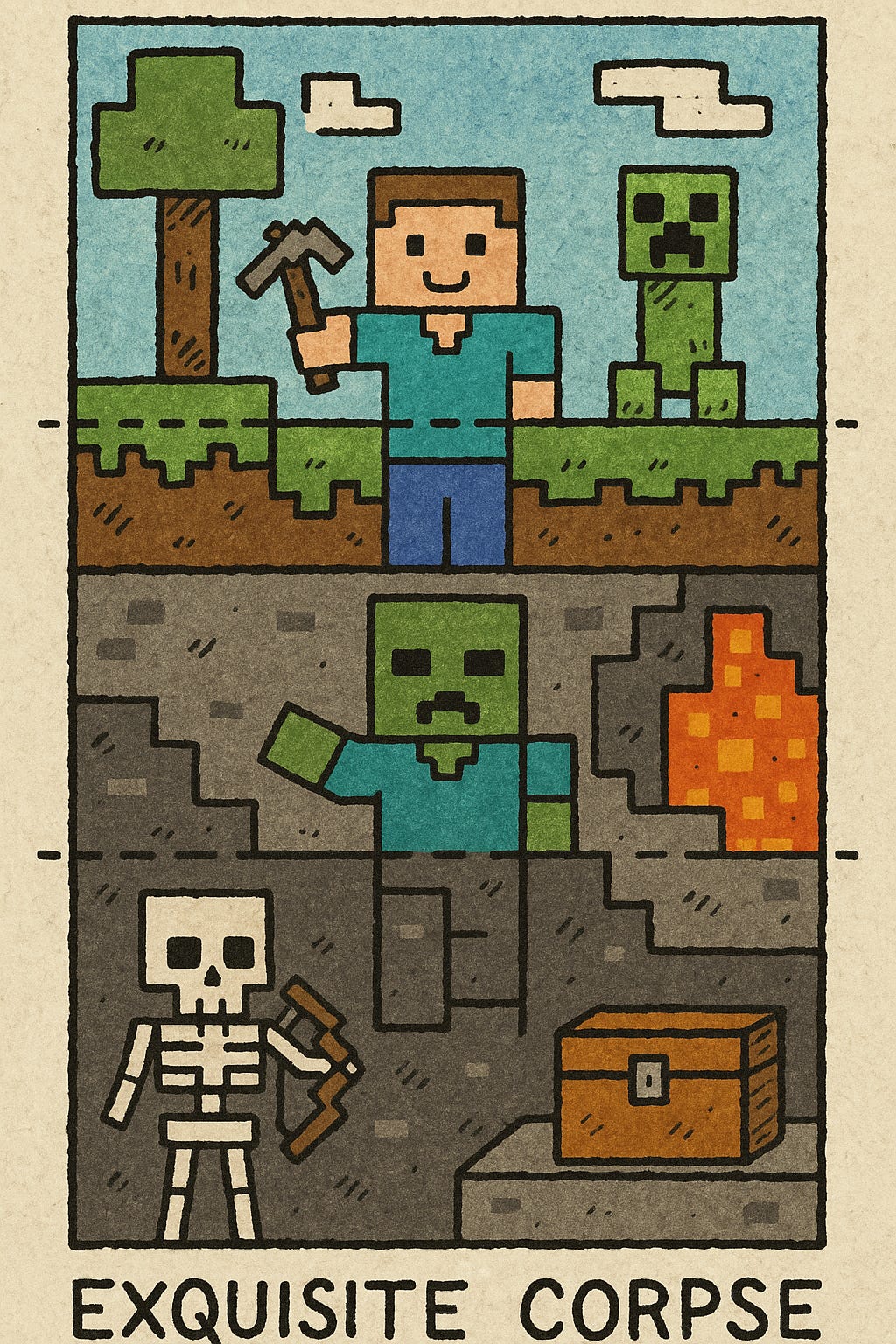
Exquisite corpse is an artistic process constructed by surrealists wherein multiple artists collaborate on a single work, while only being able to see a very limited portion of the contributions from their coartists. There is generally no particular intent of the final artwork being cohesive—the surreal outcomes produced by stitching together several unrelated pieces are an intended result of the process. The browser-based pictionarylike Gartic Phone features an exquisite corpse mode, allowing you and a group of friends, enemies, lovers, kismeses, or disinterested acquaintances to experience exquisite corpse for yourselves.
Speedrunning Minecraft, but Every Minute the Player Changes
Recently, my apartment watched the four-month old YouTube video
wherein a novel Minecraft 1.16 RSG-based speedrunning challenge is attempted. The idea is that a collection of speedrunners passes a Minecraft world file around, each only permitted to play the game for one minute—but the attempt goes disastrously awry as the players keep dying, and eventually they begin repeatedly looping back through their list of players. While players were mostly meant to only be able to infer the status of the speedrun based on what they could observe when they loaded the world (and their memories from their previous one-minute intervals), some accidental44 This is mostly a guess, I wasn’t paying that much attention and also don't really care about slightly imperfect implementation of the theoretical category rules. outside discussion about the state of the run seems to have occurred.
I think it seems reasonable, though Andronicus did not do so, to characterize this as a Minecraft speedrunning exquisite corpse. It differs from an exquisite corpse in that an exquisite corpse is an open-ended artistic endeavor while a Minecraft speedrun has a clearly-defined scoring criterion, but the restriction is highly similar: a team completes a task which would often be performed by a single person, while lacking much ability to communicate.
Many aspects of the speedrun were pretty impressive—I have only a loose understanding of the current 1.16 RSG strategies and would have issue executing many of them even in conditions much more favorable than this. And it makes sense that, this being (to my knowledge) the first time something like this has been attempted, the metagame would not be fully developed. Also, I expect I would have very little to offer a competent team of fifteen to twenty-five speedrunners seriously attempting this as a speedrun category, who would probably mostly not end up diverging very much from a normal Minecraft speedrun performed by one player.
Nonetheless, I had some thoughts.
Signs
The speedrunners in Speedrunning Minecraft, but Every Minute the Player Changes mostly convey verbal information through the use of the sign, a Minecraft block that allows the player to write and display text. This is a sensible choice, as a set of three signs can be crafted with the use of only three wooden logs—and that’s including the four planks used to build a crafting table. I think it is a pretty decent strategy for a speedrun that goes mostly smoothly, wherein almost the entirety of the information a given speedrunner needs could be quickly inferred from the basic context they find themselves in. A couple 3-5 digit numbers or a general direction are pretty much the only thing that might need to be explicitly communicated in an ideal scenario55 I suppose partial data to eventually be used in divination might also be useful? I don’t know all the details of how divination techniques can be usefully applied to speedrunning in practice (or even in theory)..
The actual speedrun in Speedrunning Minecraft, but Every Minute the Player Changes does not go smoothly—which should be largely unsurprising, given that the participants have had no prior practice with continuing a Minecraft speedrun after suddenly loading into it partway through. I think it makes sense to invest in a more ideal communication method. Signs must be physically placed in the Minecraft world, so if the players have to move to a new location—as must be done constantly throughout a speedrun—a speedrunner must place a new sign and rewrite the message just before the end of their minute. At one point the speedrunners in Speedrunning Minecraft, but Every Minute the Player Changes manage to use this method to continue pursuing an intermediate goal of finding a lava pool over several player transitions.
This works66 One issue with signs is that, perhaps unexpectedly, runners will sometimes be confused why their predecessors crafted signs and throw them out to clear their inventory. But this mistake, conveniently, is much less likely to be made by players who began their minute directly in front of a placed sign—so it mostly happens in cases where there was no important information to communicate anyways, and the signs can just be recrafted when needed., but the amount of information worth passing on will seem minimal. One can also imagine that, upon seeing a sign instructing them to look for lava, a player might assume that it’s a good idea to go along with the plan—even if, unbeknownst to them, the lava search has been unsuccessful for long enough that a change of strategy is called for.
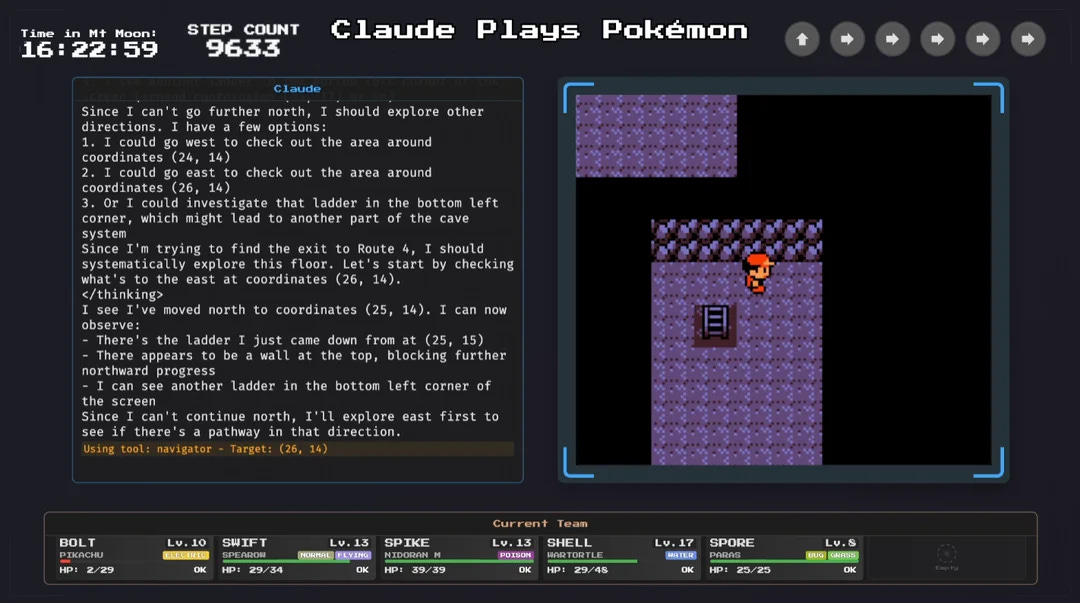
A stable information storage mechanism77 Technically, signs are stable in the sense that even after a long time period they will likely still be present at the location they were originally placed. This does, in fact, end up helping the speedrunners in Speedrunning Minecraft, but Every Minute the Player Changes avoid wasting time in previously-looted structures. So more specifically, an information storage mechanism that is both stable and transportable would be useful. would be useful. Players might be more willing to note down potentially-helpful information if it doesn’t add as much overhead to further players and isn’t as certain to be forgotten.
Minecraft has limited ways of storing text. Command blocks are both unable to be interacted with and immovable for players in the survival gamemode. Some sort of inventory arrangement code is possible, and is probably even preferable to signs for serious attempts of this category, but isn’t a viable option88 It’s definitely conceivable that a clever player could look at their inventory, see a 4x2 grid of stacks each containing somewhere between 0 and 9 of the same block, and infer that this was meant to store a pair of coordinates. That’s very possibly a sufficiently Schelling interpretation.
But one would have to be remarkably clever to, not just be able to figure that out, but to reliably figure that out while trying to hurry. Admittedly, you only strictly need any specific runner to conclude that they shouldn’t mess with the thing that might be a code they didn’t understand, but I still wouldn’t want to trust this method. unless players are allowed to plan it out ahead of time.
Renaming an item99 Renaming a mob presents exactly the same difficulties, but furthermore requires both the ability to transport the mob and one name tag for every time you wish to add new data. There is no good reason to communicate data through a mob’s name.
That said, the funniest communication scheme would definitely be a device in spawn chunks that, after a long duration has elapsed, automatically puts a death message into chat containing useful information by killing a pet. could work pretty well in theory, but requires access to an anvil, which necessitates 31 iron, a woodland mansion, or a (1.20+) trail ruins. Realistically, it’s going to be the iron one. Mining 31 iron is perhaps not too utterly impractical, but it would be a considerable pain.
Here’s what I suspect the single best intervention you could do for a Minecraft speedrun exquisite corpse to be, if your turn is sufficiently early into the run:

The book and quill is a Minecraft item in which a player can write up to 100 10231010 Do these things have an internal “end of page” character or something? I don’t get it. Why is it 1023.-character pages of text, in addition to a fifteen character title that can be added when the book is completed and signed. It is crafted with a feather, an ink sac, and a book. Feathers are dropped by chickens, ink sacs are dropped by squid, and books can be crafted with three paper and a piece of leather or “borrowed” from a villager’s library. So mostly you just need some farm animals and a river, which is a little biome dependent but not ridiculous to expect you can find.
Also, it’ll be really funny when one of the players accidentally signs the book and now no one can edit it anymore.
Isn’t this cheating
I don’t think it violates any explicit rules. Also, I especially appreciate how in-game time doesn’t pass while you’re looking at a book, meaning that time spent reading or writing doesn't take away from the minute allotted to a runner1111 Many things would be easier for me if real life worked like this.. Any players who figure that out can make maximally-informed plans at their leisure, and maybe write some of them out for the next person.
Okay but doesn’t this, like, ruin the point?
Oh yeah sure that definitely seems like a reasonable reservation to have. I think using signs or inventory management codes optimally might well ruin it too? Ultimately there's a space of possible the points one could feel a given activity to have, and it will usually be a subjective judgement to decide what ruins it.
But some sort of rule about valid communication schemes seems like a reasonable thing to add! It’d be really annoying to come up with a satisfying formal definition of an “inventory arrangement code” so as to prohibit them, but if the honor rule doesn’t end up sufficing you could always fallback on something like shuffling the inventory between players.
My other main strategic conclusion was that it broadly would’ve made sense to invest more time in collecting resources, such as food and even armor. Much more caution and robustness is called for compared to a normal Minecraft speedrun, where fragility isn’t such a big deal because you can just do the next run.
It is disappointing that, as players improve, this format likely begins to pretty closely resemble a normal Minecraft speedrun. Possibly it might be more interesting to do blind playthroughs of custom world generation datapacks or even full custom-built Minecraft maps under exquisite corpse conditions—though realistically a fully developed form of such an activity would require more dedicated interest than I expect the Minecraft speedrunning exquisite corpse community to receive at any point in the foreseeable future. But it is nonetheless interesting to imagine.
Or, in some speedrun categories for some versions, upon placing an End Crystal while the End is loading (“Dragon Skip”).
And actually the technical requirement is simply to reach the end credits, which technically doesn’t necessitate a trip to the End at all in some versions.
↩Frequently, newly discovered strategies which arguably deserve to be added to the explicit list of banned techniques are regarded as prohibited, pending a moderator ruling one way or the other. You could view this as their being appended to some sort of social-consensus implicit list. Alternatively, you could view this as their having always been present on some sort of implicit list defined by what the moderators would end up ruling if they were asked to—but that’s probably ill defined.
↩The term glitch has no consistent technical definition, and probably shouldn’t be given one. Elaboration on this topic is going on the list of blog post ideas.
↩This is mostly a guess, I wasn’t paying that much attention and also don't really care about slightly imperfect implementation of the theoretical category rules.
↩I suppose partial data to eventually be used in divination might also be useful? I don’t know all the details of how divination techniques can be usefully applied to speedrunning in practice (or even in theory).
↩One issue with signs is that, perhaps unexpectedly, runners will sometimes be confused why their predecessors crafted signs and throw them out to clear their inventory. But this mistake, conveniently, is much less likely to be made by players who began their minute directly in front of a placed sign—so it mostly happens in cases where there was no important information to communicate anyways, and the signs can just be recrafted when needed.
↩Technically, signs are stable in the sense that even after a long time period they will likely still be present at the location they were originally placed. This does, in fact, end up helping the speedrunners in Speedrunning Minecraft, but Every Minute the Player Changes avoid wasting time in previously-looted structures. So more specifically, an information storage mechanism that is both stable and transportable would be useful.
↩It’s definitely conceivable that a clever player could look at their inventory, see a 4x2 grid of stacks each containing somewhere between 0 and 9 of the same block, and infer that this was meant to store a pair of coordinates. That’s very possibly a sufficiently Schelling interpretation.
But one would have to be remarkably clever to, not just be able to figure that out, but to reliably figure that out while trying to hurry. Admittedly, you only strictly need any specific runner to conclude that they shouldn’t mess with the thing that might be a code they didn’t understand, but I still wouldn’t want to trust this method.
↩Renaming a mob presents exactly the same difficulties, but furthermore requires both the ability to transport the mob and one name tag for every time you wish to add new data. There is no good reason to communicate data through a mob’s name.
That said, the funniest communication scheme would definitely be a device in spawn chunks that, after a long duration has elapsed, automatically puts a death message into chat containing useful information by killing a pet.
↩Do these things have an internal “end of page” character or something? I don’t get it. Why is it 1023.
↩Many things would be easier for me if real life worked like this.
↩